
Shoulder Rehab Reimagined: A Hybrid Robotic Exoskeleton That Tracks the Body’s Natural Motion
The shoulder is engineering marvel and vulnerability in one: a ball-and-socket joint capable of vast range, supported by a mobile girdle of clavicle, scapula, and muscles that shift the socket with every reach or lift. When injury, stroke, or frozen shoulder strikes, that complex mobility collapses into pain and stiffness. Most robotic rehab devices target only the glenohumeral (GH) joint’s three rotational degrees of freedom, ignoring the girdle’s translation. The result? Misalignment, discomfort, and suboptimal recovery.
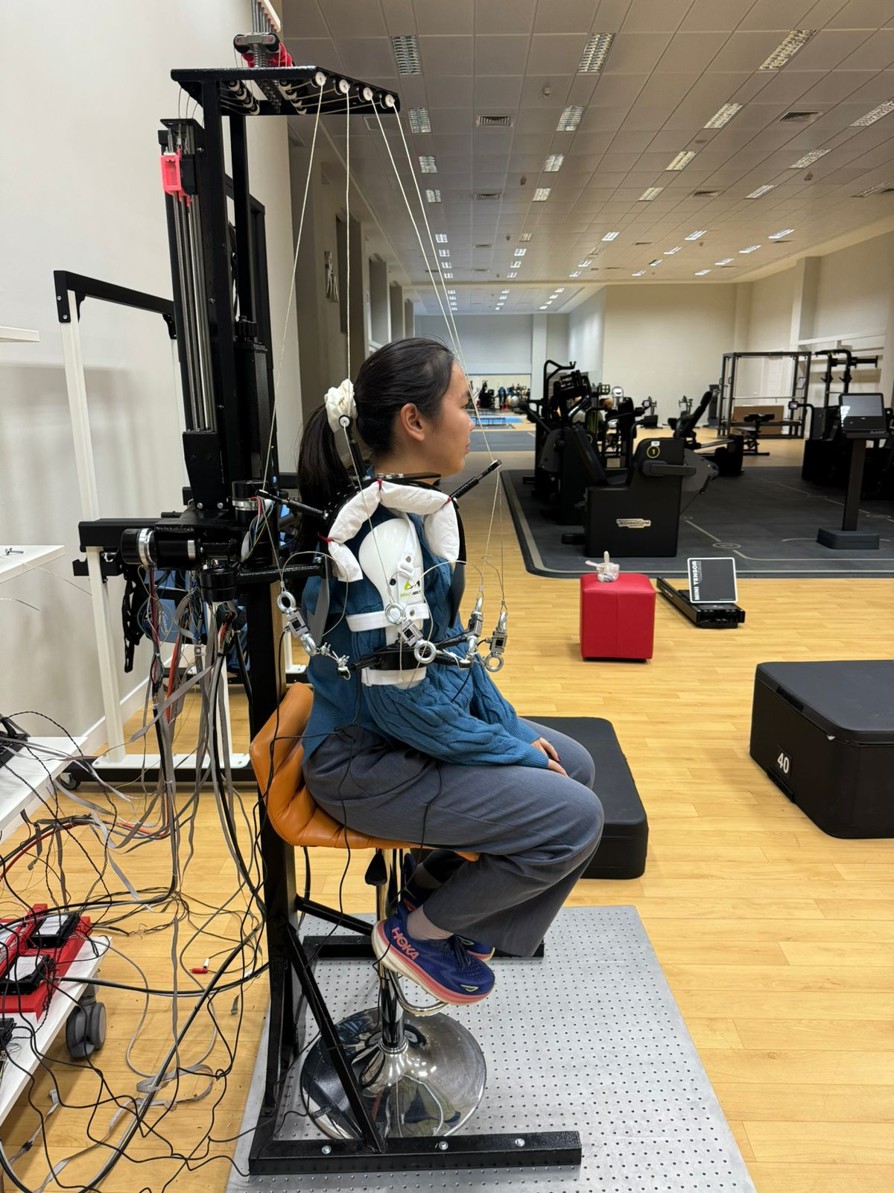
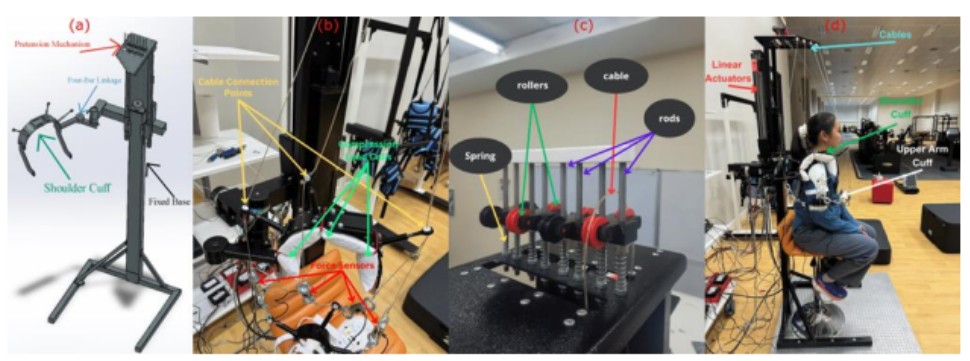
At Nazarbayev University’s Center for Excellence in Medical Robotics and Rehabilitation (CEMRR), engineers have built a prototype that tackles both: the HYBRID-2 shoulder exoskeleton. It fuses a four-link mechanism to faithfully mimic shoulder-girdle motion with a cable-driven parallel mechanism (CDPM) for smooth GH-joint rotation, delivering five anatomically aligned degrees of freedom in a compact, adjustable package.
Two Mechanisms, One Coordinated System
The design draws from earlier work (HYBRID-1 and CAREX-inspired systems) but introduces key upgrades for better alignment and comfort.
Four-Link Mechanism (RRRR Configuration) for Shoulder Girdle A crank-rocker four-bar linkage simulates clavicle and scapula movement, providing two active degrees of freedom (elevation/depression and protraction/retraction).
Links satisfy Grashof’s criterion (AB + AD ≤ BC + CD), allowing full crank rotation without locking.
Measured lengths: AB (crank) = 70.29 mm, AD (fixed) = 120 mm, BC = 103.19 mm, CD = 99.7 mm.
MATLAB kinematic equations and SOLIDWORKS simulations confirm swing angles match human norms with <2° deviation.
This mechanism keeps the exoskeleton’s virtual GH center close to the real one as the girdle moves—avoiding the painful shear forces common in rigid-frame devices.
Cable-Driven Parallel Mechanism (CDPM) for Glenohumeral Rotation
Four cables suspend an upper-arm cuff from a shoulder cuff, actuating three rotational DOF (flexion/extension, abduction/adduction, internal/external rotation).
Cable lengths are computed for every pose using rotation/position matrices tied to biomechanical constraints.
Errors between MATLAB calculations and CAD verification stay under 1–2 mm.
Cables replace rigid links, expanding workspace, reducing weight on the arm, and minimizing singularities. A novel pre-tensioning system eight rods with spring-loaded roller holders maintains constant positive tension, preventing slack or derailment even under load.
From Miniature Model to Functional Prototype
Development started with a scaled SOLIDWORKS model: shoulder/scapula cuffs, links, axles, and tension elements all 3D-printable. Universal and revolute joints were optimized for smooth motion; cable pre-tensioning was integrated early.
The full-scale HYBRID-2 prototype builds on these lessons:
Base support anchors actuators behind the user (reducing arm weight).
Shoulder-girdle subsystem swaps the prior inverted slider-crank for the crank-rocker four-bar.
Extra base support boosts stability.
Adjustable cuff attachment points accommodate different arm sizes and future sensor placements.
Pre-tensioning uses compressible springs and low-friction rollers; initial holders are 3D-printed, with metal upgrades planned.
Actuators remain ground-mounted; only lightweight cables and cuffs reach the arm.
Experimental Results: Real Users, Real Performance
To test HYBRID-2 under realistic conditions, twelve Nazarbayev University students (mixed gender, varying heights, arm lengths, and torso widths) participated in five single-DOF tasks. Each task targeted one isolated motion, yaw (rotation around vertical axis), roll (around longitudinal axis), pitch (around transverse axis) via CDPM cables, plus two girdle motions (pitch and roll) via rotary actuators in the four-bar mechanism.
Participants sat upright in an adjustable chair; shoulder-cuff height and padding were customized for comfort and alignment. Each task consisted of three sinusoidal reference trajectories; the team recorded mean maximum motor position error (δ%) and drive current (A) per run.
Key findings:
CDPM cable tasks (yaw, roll, pitch): Roll demanded the highest current—gravity makes upward shoulder lift harder than horizontal rotation. Yaw and pitch were more energy-efficient.
Four-bar rotary tasks: Higher gear ratios in rotary actuators consumed less current than linear cable pulls, thanks to mechanical advantage.
Anthropometric influence: Taller participants (e.g., Subject 1) showed larger position errors (~5%) and higher currents/torques due to longer moment arms. Smaller torso width and arm diameter correlated with lower energy use, even among taller subjects.
Overall accuracy: Position errors ranged 2–5%, with most under 3%—acceptable for rehab where smooth, safe motion trumps sub-millimeter precision. Current draw stayed within motor limits, confirming no overload risk.
These results highlight HYBRID-2’s sensitivity to body geometry—height, shoulder width, arm diameter—all affect torque and tracking error. This data fills a research gap: previous cable-driven shoulder systems rarely quantified how human variability impacts electrical and mechanical behavior.
Why Alignment Matters—and How This Design Delivers
Conventional shoulder robots often fix the GH center, but real shoulders translate 10–20 mm with girdle motion. Misalignment causes pain, reduced range, and poor motor relearning. HYBRID-2 counters this by coupling girdle tracking (four-bar) with GH actuation (CDPM), keeping joint centers synchronized.
Early validation shows promise:
Kinematic errors <2° (four-bar) and <2 mm (CDPM).
Larger workspace than rigid-link designs.
Adjustable elements fit diverse body sizes.
Compared with existing cable-driven or serial shoulder exoskeletons (most limited to 3 DOF without girdle compensation), HYBRID-2 stands out for anatomical fidelity.
Next Steps: Control, Tension, and Clinical Trials
Work continues on:
Integrated control: simultaneous four-cable CDPM positioning with encoder feedback.
Positional impedance controller using force/torque sensors.
Tension optimization algorithm to maintain positive cable forces.
Cable redesign to cut friction and elongation.
Position + torque strategies for safe, compliant assistance.
The prototype already proves the hybrid concept viable, lightweight on the arm, accurate in motion, adaptable to users. If upcoming trials confirm safety and efficacy, HYBRID-2 could offer stroke survivors, rotator-cuff patients, and frozen-shoulder cases a more natural path to recovery: a robot that moves with the shoulder, not against it.
In rehab robotics, precision isn’t just technical, it’s human. When the machine finally understands the shoulder’s dance, patients can once again reach without fear.
https://ieeexplore.ieee.org/stamp/stamp.jsp?arnumber=11036249 https://www.tandfonline.com/doi/pdf/10.1080/15397734.2025.2468730