
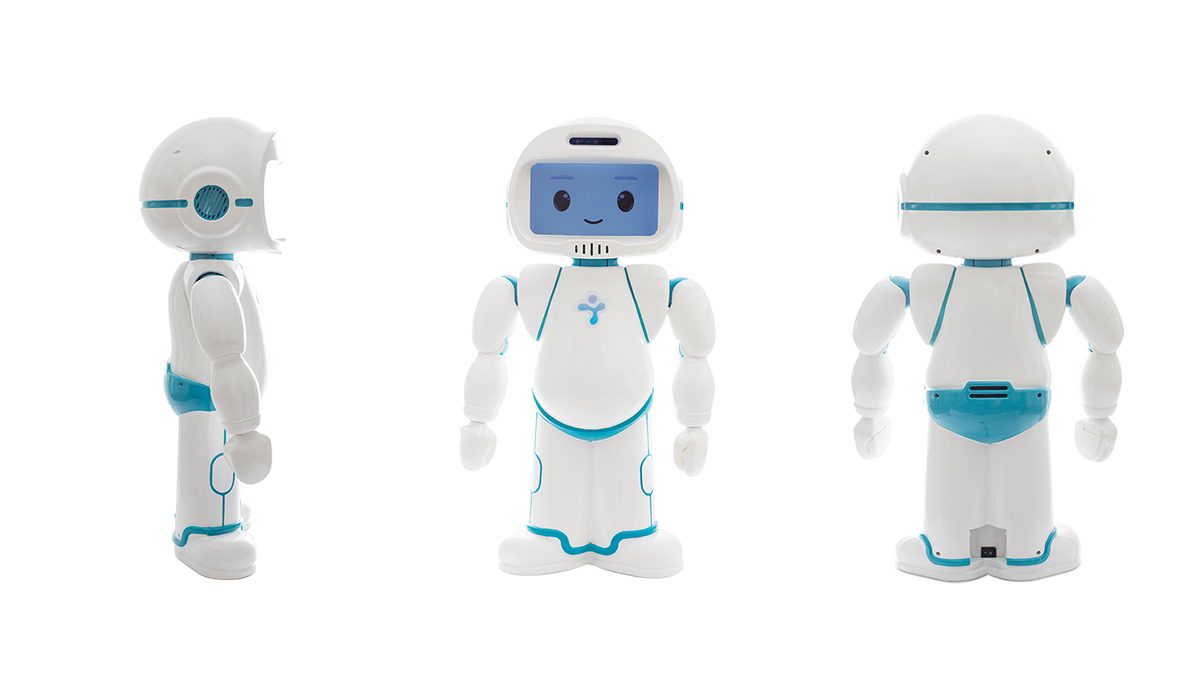
QTrobot & Mobile Avatar Interventions to Improve Communication in Children with Cerebral Palsy QTrobot Interventions at NCCR
Pediatric rehabilitation is often discussed in terms of gait and motor recovery, but for many children with Motor Movement Disorders (MMD), progress also depends on what happens beyond movement: attention control, reciprocal communication, emotional expression, and the confidence to engage socially. This is where social robotics becomes more than a novelty. In a structured clinical setting, a humanoid robot can deliver consistent, repeatable interaction routines, while therapists observe, support, and document changes with a level of detail that is hard to sustain in purely manual sessions.
At the National Center for Children’s Rehabilitation (NCCR) in Astana, within the broader CEMRR project, a pilot stage was conducted to evaluate the feasibility, acceptability, and preliminary effectiveness of QTrobot-based social and cognitive interventions delivered in Kazakh and Russian.
A Robot That Never Tires
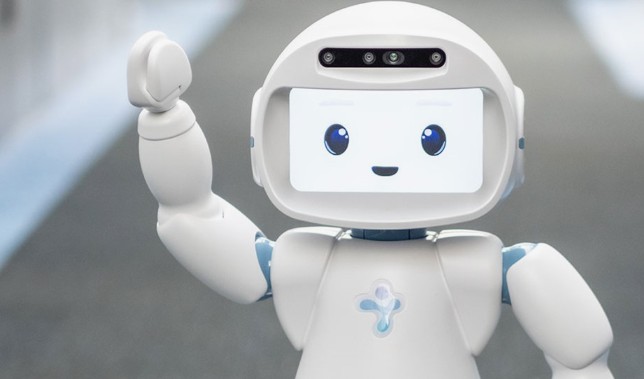
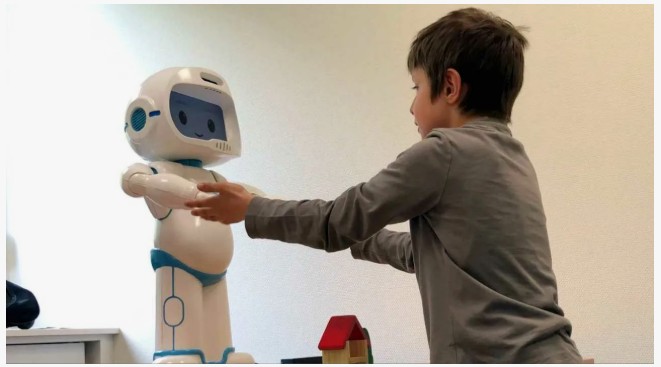
Picture a small, expressive humanoid robot sitting across from a 7-year-old in a quiet therapy room in Astana. The robot smiles, waves, and says in perfect Kazakh: “Hello! My name is QTrobot. What’s your name?” The child hesitates, then answers. A few minutes later, they’re taking turns describing feelings on colorful cards, imitating silly faces, or joining in a short story. No therapist is speaking for the robot—the conversation flows naturally, guided by an AI brain behind the scenes.
This isn’t a science-fiction scene. It’s happening now at the National Center for Children’s Rehabilitation (NCCR), where researchers from Nazarbayev University have turned QTrobot—a commercially available social robot—into a bilingual, AI-enhanced partner for children with cerebral palsy (CP) and other motor disorders.
Cerebral palsy often brings motor challenges, but many kids also face hurdles in social communication: reading emotions, taking turns in conversation, expressing themselves, or sustaining attention. Traditional therapy relies on one-on-one sessions with speech therapists or psychologists, which works but can feel repetitive and therapist-dependent. Enter social robotics: consistent, patient, endlessly repeatable interactions that never tire or judge.
The Pilot Program and Measurable Gains
In a recent pilot at NCCR, 20 children aged 7–10 (a subset drawn from a broader pool of 5–12-year-olds with mild-to-moderate motor impairments, GMFCS Levels I–III) completed a structured three-week program. Each child met individually with QTrobot for ten 20–30-minute sessions. Parents gave full informed consent in Kazakh or Russian; kids gave assent where possible. Therapists supervised every session for safety and support, especially for children with lower verbal abilities.
The team developed ten bilingual scripts targeting key social-cognitive skills:
Greeting and starting conversations
Turn-taking and waiting patiently
Recognizing and naming emotions
Imitating gestures and expressions
Guided storytelling and perspective-taking
QTrobot delivered these through speech, animated facial expressions, arm gestures, and a friendly voice. For children who spoke little or not at all, the robot adapted—using more visuals, simpler prompts, or waiting longer for responses.
Measuring the Mind: WISC-V Gains and Beyond
Using the Wechsler Intelligence Scale for Children – Fifth Edition (WISC-V), the intervention group (QTrobot sessions) gained an average of 7 points in Full-Scale IQ (FSIQ) over three weeks—more than double the modest 3-point gain in the control group, which received equivalent therapist-led social activities without the robot. Social Responsiveness Scale (SRS) trends also favored the robot group, showing gains in social awareness and communication.
These weren’t huge leaps, but in pediatric rehab, small shifts matter: a child who once avoided eye contact now initiates greetings; one who struggled with turn-taking now waits and responds spontaneously. Therapists noted a clear rise in independence—kids engaged more freely with the robot over time, requiring less prompting even at lower verbal levels.
Technology, Impact, and the Path Forward
The big upgrade? Integration of Google’s Gemma2-9b-it large language model via the Groq API. This added real-time adaptability: the robot could paraphrase questions, respond contextually, adjust difficulty based on the child’s replies, and even switch seamlessly between Kazakh and Russian (or handle code-switching, common in bilingual Kazakh households). Average response latency stayed under 2 seconds, speech recognition hit >90% accuracy for clear speech, and clever voice-activity detection cut unnecessary API calls by about 60%.
Results were encouraging. Using the Wechsler Intelligence Scale for Children – Fifth Edition (WISC-V), the intervention group (QTrobot sessions) gained an average of 7 points in Full-Scale IQ (FSIQ) over three weeks, more than double the modest 3-point gain in the control group, which received equivalent therapist-led social activities without the robot. Social Responsiveness Scale (SRS) trends also favored the robot group, showing gains in social awareness and communication.
These weren’t huge leaps, but in pediatric rehab, small shifts matter: a child who once avoided eye contact now initiates greetings; one who struggled with turn-taking now waits and responds spontaneously. Therapists noted a clear rise in independence, kids engaged more freely with the robot over time, requiring less prompting even at lower verbal levels.
The robot proved reliable: no crashes, solid bilingual performance, and multimodal engagement (voice + face + gestures) kept attention high across ability levels. Five initial scripts were tested and refined; ten full AI-enhanced versions are now ready. The codebase is documented and version-controlled for future scaling.
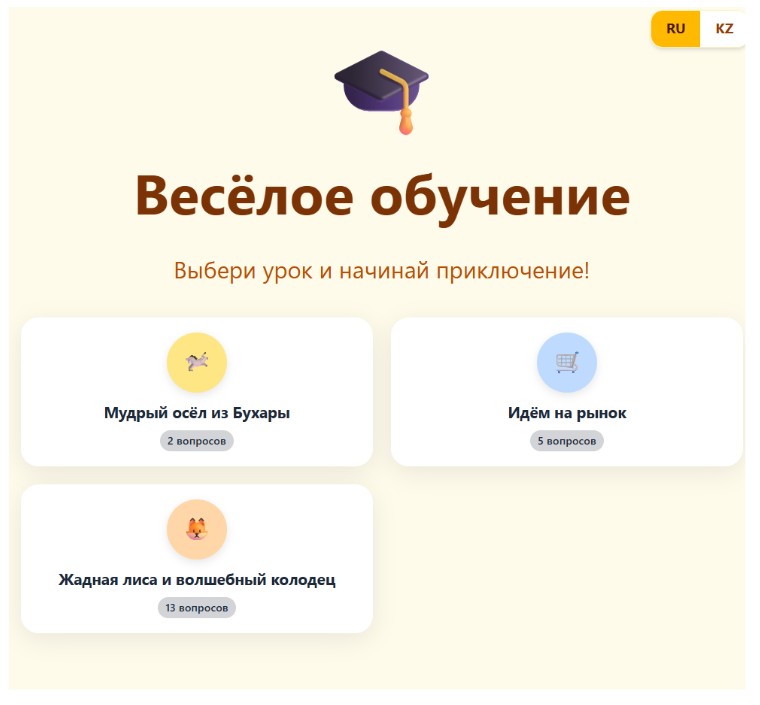
To turn this work into something usable in real therapy settings, we built a dedicated child-focused QTrobot web application (qtrobot-app.vercel.app). The app was designed to help children practice social, emotional, and cognitive skills through short, structured robot-led sessions, making therapy more engaging, more consistent, and easier to deliver at scale. It provides a simple interface for launching scripted activities, guiding the interaction flow, and supporting bilingual delivery (Kazakh/Russian), so children can learn in the language mix they naturally use at home.
Why Kids Opened Up & Deliverables and the Road Ahead
Social robots offer what human therapists can’t always provide in resource-limited settings: infinite patience, perfect consistency, and 24/7 availability in theory. For families in Kazakhstan, where geographic spread and therapist shortages are real, the robot acts as a bridge, extending therapy reach without replacing human care.
Challenges remain: fine-tuning AI for very low-verbal or highly distractible kids, ensuring cultural nuances in scripts, and validating long-term gains in larger trials. But the pilot’s deliverables are solid: 20 kids successfully participated, bilingual implementation validated, baseline data collected, therapist protocols established, and a clinically safe AI-robot system prepped for broader deployment.
In Astana’s rehab rooms, QTrobot isn’t just a gadget, it’s becoming a companion that helps children practice the social world one friendly “hello” at a time. If the trends hold in upcoming studies, social robotics could quietly reshape how we support the hidden cognitive side of cerebral palsy: not just stronger legs, but stronger connections to people around them.
https://link.springer.com/article/10.1186/s12984-025-01852-0