
Robot-Assisted Gait Rehabilitation for Improved Walking
In the corridors of the National Center for Children’s Rehabilitation (NCCR) in Astana, children with cerebral palsy are walking paths that look ordinary but represent something extraordinary: steps guided by robots.
Cerebral palsy (CP) disrupts movement and posture due to early brain damage, often leaving children with unsteady gaits, poor balance, and challenges in social interaction. Traditional therapy, manual stretching, treadmill walking with therapist support, speech drills helps, but progress can be slow and inconsistent. Now, a suite of homegrown robotic systems is changing the equation, delivering precise, repeatable, and engaging interventions that therapists alone cannot match.
At the heart of the effort are three technologies developed or deployed through a collaboration between Nazarbayev University’s Center for Excellence in Medical Robotics and Rehabilitation (CEMRR) and NCCR:
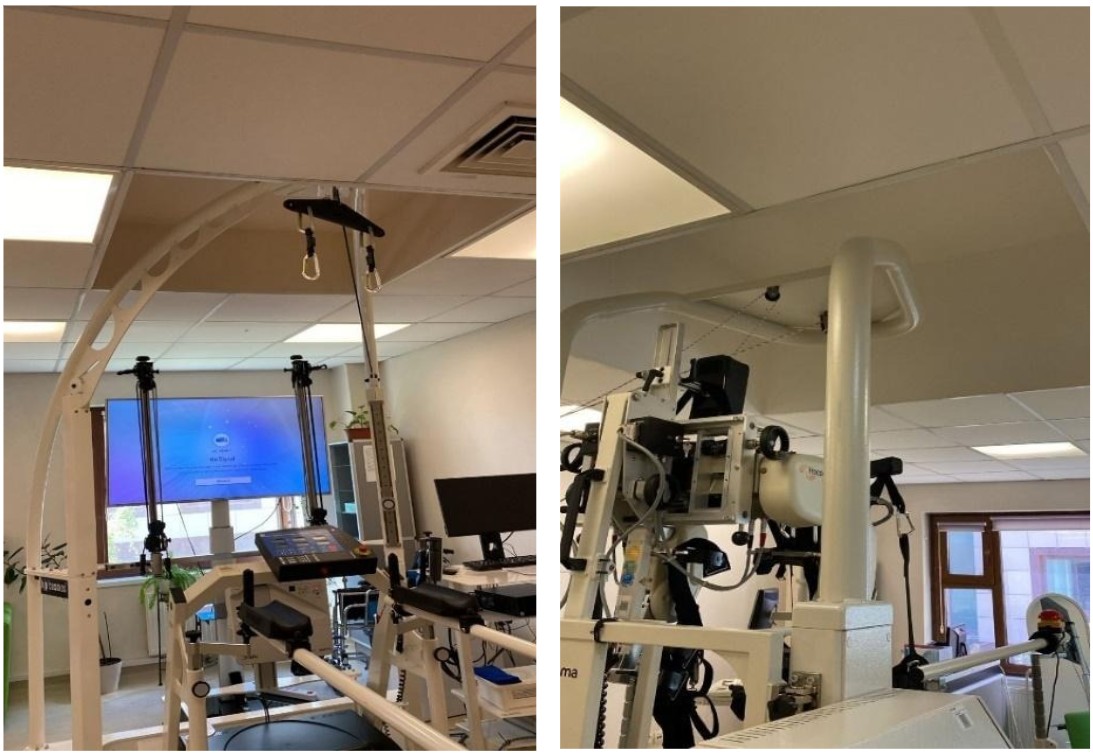
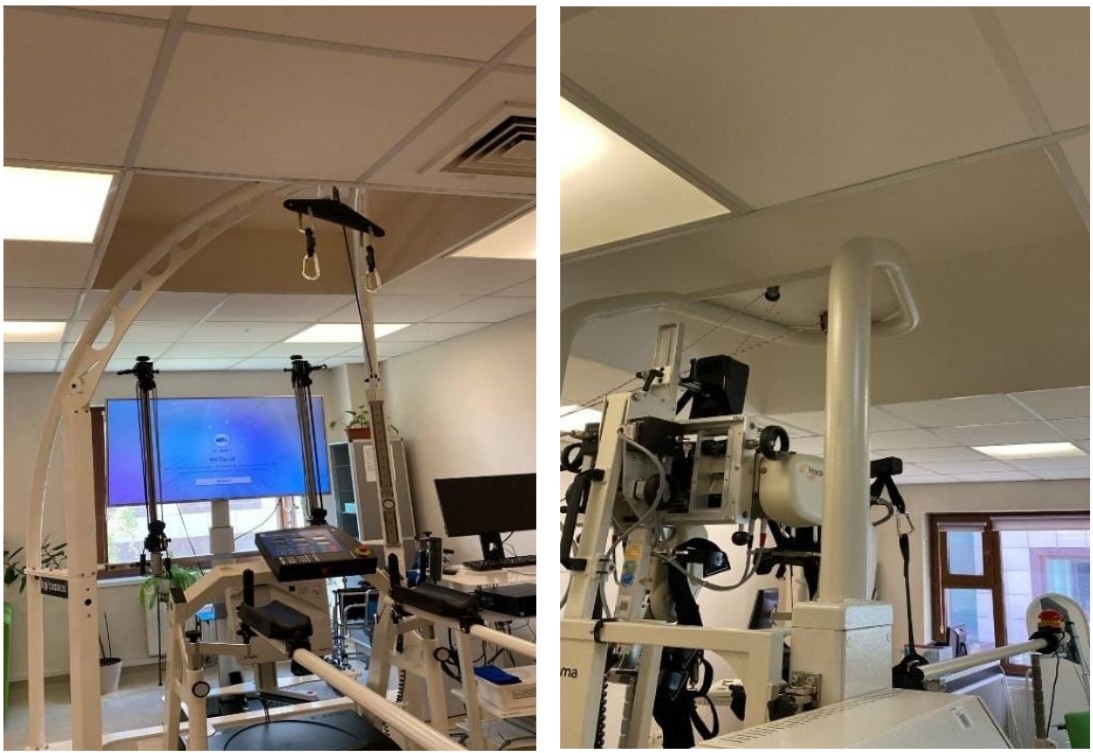
P.GEAR - the Pediatric Gait Exoskeleton Assisted Rehabilitation system, a treadmill-mounted robotic exoskeleton built at Nazarbayev University. It supports children’s legs during walking, providing adjustable assistance to promote more natural stride patterns and longer endurance.
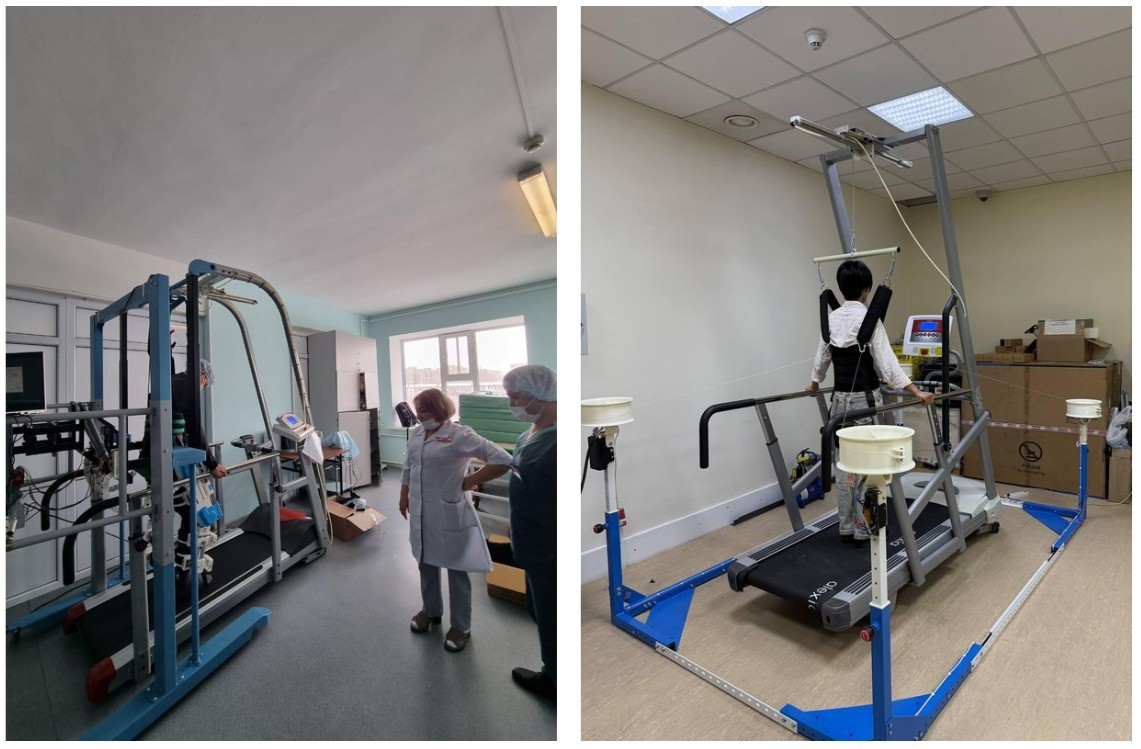
Robotic Perturbation Trainer (RPT) - a companion device that applies controlled “nudges” or perturbations to the pelvis or legs while the child walks. The goal: train core and pelvic muscles to react quickly, building the dynamic stability needed to prevent falls and improve confident locomotion.
QTrobot - a commercially available humanoid social robot adapted with bilingual (Russian and Kazakh) scripts for structured communication and behavioral training sessions.
These systems are not futuristic demos; they are installed and running pilot clinical trials right now at NCCR, one of the region’s leading pediatric facilities (and the only one in Eastern Europe and Central Asia with Joint Commission International accreditation).
Walking Farther, One Robot-Assisted Step at a Time
The most mature thread is P.GEAR-based gait training. In an early pilot, researchers recruited 12 children with CP (Gross Motor Function Classification System levels I–III, ages roughly 5–18). Six received nine sessions over three weeks using the exoskeleton with “assist-as-needed” control, meaning the robot provides just enough support to complete the task but gradually reduces help to encourage active effort. The other six continued with standard therapist-guided treadmill walking.
The key yardstick was the Six-Minute Walk Test (6MWT), a simple but reliable measure of functional endurance: how far a child can walk in six minutes. After the intervention, the robot group showed an average improvement of about 44 meters more than the control group, with a pooled standard deviation of 62.5 meters. That difference, while modest in absolute terms, is clinically meaningful for children whose daily mobility is severely limited. Power calculations from this pilot are now guiding a larger, longitudinal trial planned for 2026.
A second pilot took the concept further by pairing P.GEAR with immersive virtual reality (VR). Five children in the intervention arm walked in a VR environment (think scenic paths, obstacles, or games that reward steady pacing) while the exoskeleton provided physical support. Again, controls received conventional therapy. The 6MWT served as the primary endpoint, with the combined P.GEAR+VR arm designed to boost motivation and engagement—critical factors when working with children who may tire quickly or lose focus
Perturbations to Build Balance
Balance is often the hidden bottleneck in CP gait. Even if a child can walk, a slight uneven surface or unexpected shove can cause a fall. The Robotic Perturbation Trainer addresses this directly. While the child walks on the treadmill, the RPT delivers targeted forces to the pelvis or trunk, mimicking real-world disturbances like a bump or sudden turn. The repeated exposure is intended to strengthen reactive muscle responses and improve postural control.
Clinical trials for RPT are in planning, building on the same rigorous framework: randomized allocation, stratified by CP subtype and GMFCS level, blinded assessors, and baseline measures including Berg Balance Scale, Timed Up and Go, and sensor-based gait analysis (EMG for muscle timing, IMUs for kinematics, insoles for pressure distribution).
Social Robots Enter the Conversation
Not all challenges in CP are motor. Many children also face delays in communication, attention, and social reciprocity. Here, QTrobot steps in—literally a small humanoid with expressive face and arms that can demonstrate gestures, maintain eye contact, and deliver scripted interactions.
In a pilot with 20 children (10 intervention, 10 control), the robot led ten sessions over three weeks. Each session used one of ten custom bilingual scripts focusing on turn-taking, emotion recognition, simple conversations, and behavioral modeling. Outcomes combined quantitative scores from the Wechsler Intelligence Scale for Children (WISC-V) with qualitative notes from therapists on engagement and progress in social skills.
The aim was not to replace human therapists but to provide consistent, tireless repetition of foundational exercises, something especially valuable in resource-constrained settings.
Rigorous Design Behind the Robots
All trials follow gold-standard randomized controlled designs. Allocation uses computer-generated permuted blocks (sizes 4 and 6), stratified by key variables, and concealed via sealed opaque envelopes. Inclusion targets children aged 13–18 with CP who can follow instructions and tolerate treadmill activity; exclusions cover recent surgeries, severe contractures, or uncontrolled seizures.
Baseline and outcome assessments are blinded, and protocols align with Good Clinical Practice guidelines. This methodological care ensures the data will support credible claims about efficacy, and guide decisions on scaling these interventions across Kazakhstan and beyond.
What’s Next
These pilots are small by design-limited by patient availability and the need to refine protocols, but they have already yielded actionable effect sizes and sample-size estimates for 2026’s larger studies. If the trends hold, P.GEAR could become a standard tool for boosting walking endurance, RPT a go-to for fall prevention, and QTrobot a scalable aid for social-communication goals.
For families in Astana and across Central Asia, the promise is tangible: more independent steps, fewer falls, richer conversations, all supported by robots that never tire. In a field where progress is often incremental, these robotic companions represent a meaningful acceleration.
The robots are already walking the halls at NCCR. Soon, the evidence may show they are helping children walk farther, steadier, and more confidently into the world