Revolutionizing Pediatric Neurorehabilitation using Robots How AI, Robotics, and Immersive Tech Are Transforming Pediatric Rehabilitation in Kazakhstan
Motor Movement Disorders (MMD), including conditions such as cerebral palsy, remain one of the leading causes of lifelong disability in children. For many families, the challenge isn’t only weakness or limited mobility; it’s the daily uncertainty of gait instability, poor balance, and reduced motor coordination that can affect independence for years. Conventional rehabilitation can be effective, but it is often constrained by a familiar trio of limitations: outcomes depend heavily on therapist expertise, therapy intensity varies from session to session, and progress is difficult to measure objectively beyond clinical observation.
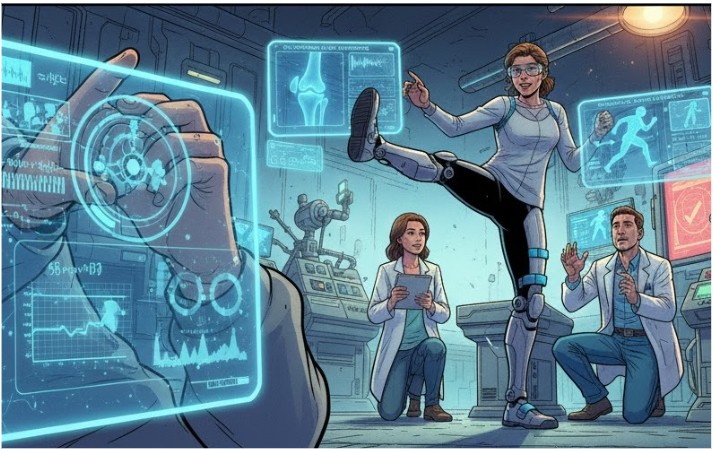
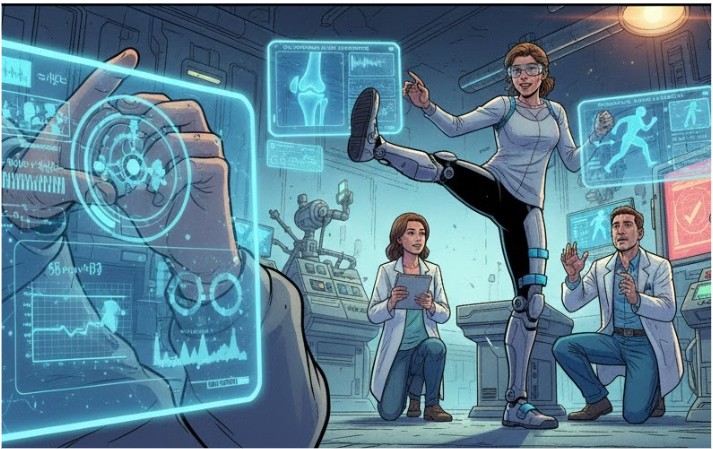
A new generation of rehabilitation research is changing that equation by combining robotics, artificial intelligence (AI), and AR/VR environments to make therapy more precise, reproducible, and engaging. Building on this global shift, a multidisciplinary team at Nazarbayev University’s Center of Excellence in Medical Robotics and Rehabilitation (CEMRR) is developing an integrated framework designed specifically for children with MMD, aiming not only to support movement, but to quantify it, personalize it, and ultimately improve quality of life.
From “Therapy as Art” to Therapy with Measurable Signals
At the heart of the project is a simple idea: rehabilitation improves when clinicians can see what is changing—objectively, consistently, and over time. The team’s approach combines standard clinical assessments, including the Six-Minute Walk Test (6MWT), Ten-Meter Walk Test (10MWT), Timed Up and Go Test (TUGT), Gross Motor Function Measure (GMFM), and Pediatric Balance Scale (PBS), with multimodal sensor measurements such as electromyography (EMG), inertial measurement units (IMUs), and insole pressure mapping.
This fusion creates quantitative indices that capture gait quality, balance strategies, fatigue patterns, and movement symmetry, turning rehabilitation into a data-supported pathway rather than an experience evaluated mainly by observation. In practical terms, it means a child’s progress can be tracked not only by “better” or “worse,” but through measurable signals that allow therapists and researchers to refine intervention intensity and timing.
Two New Robotic Platforms: P.GEAR and RPS
A defining achievement of the project is the development of two novel robotic systems that strengthen Kazakhstan’s capacity in pediatric medical robotics:
P.GEAR (Pediatric Gait Exoskeleton Assisted Rehabilitation) is designed to support gait training and improve movement patterns through controlled assistance.
RPS (Robotic Perturbation System) targets balance by introducing controlled perturbations that challenge postural stability, helping children develop safer, more adaptive balance responses.
Together, these platforms move beyond “support” into structured rehabilitation: repeatable sessions, tunable difficulty, measurable outcomes, and data streams that feed learning algorithms and clinical decision-making.
Rehabilitation Beyond Movement: A Social Robot That Speaks the Child’s Language
Physical recovery is only one piece of pediatric neurorehabilitation. Many children with MMD also need support in communication, attention, motivation, and social interaction, domains that influence participation and long-term development.
To address this, the project includes QTrobot, a humanoid social robot programmed in Kazakh and Russian, extending therapy into cognitive and social dimensions. This matters: children engage more deeply when the interface is culturally and linguistically natural, and when therapy feels interactive rather than purely corrective. By designing for communication and social engagement, the project aligns with modern neurodevelopmental thinking, where progress is measured not only by steps, but by confidence, participation, and connection.
AR/VR: Turning Repetition into Engagement
The integration of AR/VR interfaces with robotic systems introduces immersive, gamified therapy environments that can sustain motivation across repeated sessions. In pediatric rehabilitation, engagement is not a “nice add-on”—it’s often the deciding factor in whether therapy intensity is sufficient to drive neuroplasticity.
By embedding motor tasks inside interactive, goal-driven scenarios, AR/VR can increase adherence and make difficult exercises feel purposeful—supporting both physical outcomes and the child’s emotional experience of therapy.
A National Program with a Clear Translation Path
This work is implemented under the Program-Targeted Funding (PTF) scheme of the Ministry of Science and Higher Education of the Republic of Kazakhstan through the project titled “Improving the rehabilitation and support of children with musculoskeletal disorders and neurological disorders using innovative robotic devices.” It is conducted within CEMRR under Nazarbayev University Research Administration (NURA), registered with the National Center of Science and Technology Evaluation (NCSTE) under grant number [0125PK00553], for the funding period 2025–2026.
Led by Principal Investigator Professor Prashant K. Jamwal and supported by a multidisciplinary team of engineers, medical scientists, and graduate researchers, the program aims to deliver a suite of robotic, sensor-based, and AI-integrated rehabilitation systems focused on improving gait, balance, and social interaction in children with MMD.
Beyond the lab, the project is positioned as a direct contribution to Kazakhstan’s broader digital healthcare priorities, aligning with national efforts in digital transformation and AI-enabled medical innovation (including strategic resolutions referenced as No. 945 and No. 269, 2022–2023).
Why It Matters
Scientifically, the project sits at the intersection of biomechanics, control systems, cognitive robotics, and data-driven modeling—exactly where the future of pediatric neurorehabilitation is being built. Clinically, it aims to deliver what families and therapists need most: more consistent therapy, clearer feedback, and tools that help children progress with confidence.
In the long run, the promise is bigger than any single device: a rehabilitation ecosystem where movement support, objective measurement, adaptive AI, and child-friendly engagement work together—turning recovery into a pathway that is not only more effective, but more human.