When Shoulder Rehab Meets Smart Robotics: What 32 Studies Tell Us About the Next Wave of Stroke Recovery. A Systematic Review
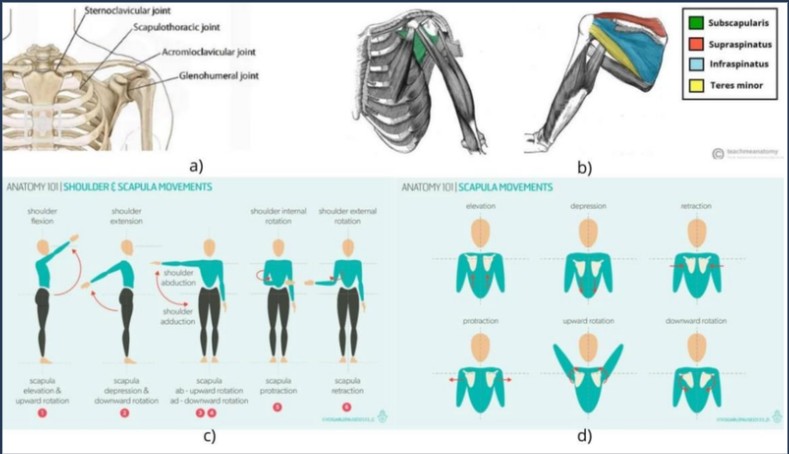
Stroke continues to be a major cause of persistent upper limb impairment, with conventional rehabilitation constrained by high resource demands, inconsistent delivery, and limited scalability. While early end-effector robotic systems have shown benefits for distal (wrist/hand) tasks, they often inadequately address the complex, multi-joint dynamics of the shoulder girdle. Wearable exoskeletons that align with anatomical joint axes offer potential advantages in delivering targeted, segment-specific assistance (shoulder, forearm, hand) and mitigating pathological synergies. This systematic review synthesizes sensor technologies, actuation methods, and control strategies in shoulder-focused exoskeletons, emphasizing clinical translation and applicability.
A PRISMA-compliant search across PubMed, Web of Science, Scopus, ScienceDirect, and IEEE Xplore (English-language publications, 2015–April 2025) targeted upper limb/shoulder rehabilitation exoskeletons, excluding lower limb, industrial, or non-clinical studies. Initial yield: 19,052 records; post-filtering and duplicate removal: 1,178; after topic exclusion: 248; full-text screening: 32 high-quality studies (primarily clinical trials or advanced prototypes) met inclusion criteria.
Data extraction classified key elements: sensor types (EMG, IMU, force/torque, kinematic, multimodal), control approaches (force/admittance, adaptive assist-as-needed, human-in-the-loop, passive/gravity compensation, ML-based predictive), actuation (motor, cable, passive springs, soft pneumatic), target segments (shoulder-only or full upper limb), and clinical metrics (participant type, sample size, Fugl-Meyer/ARAT/ROM outcomes, setting). Risk of bias was evaluated via ROBIS by independent reviewers.
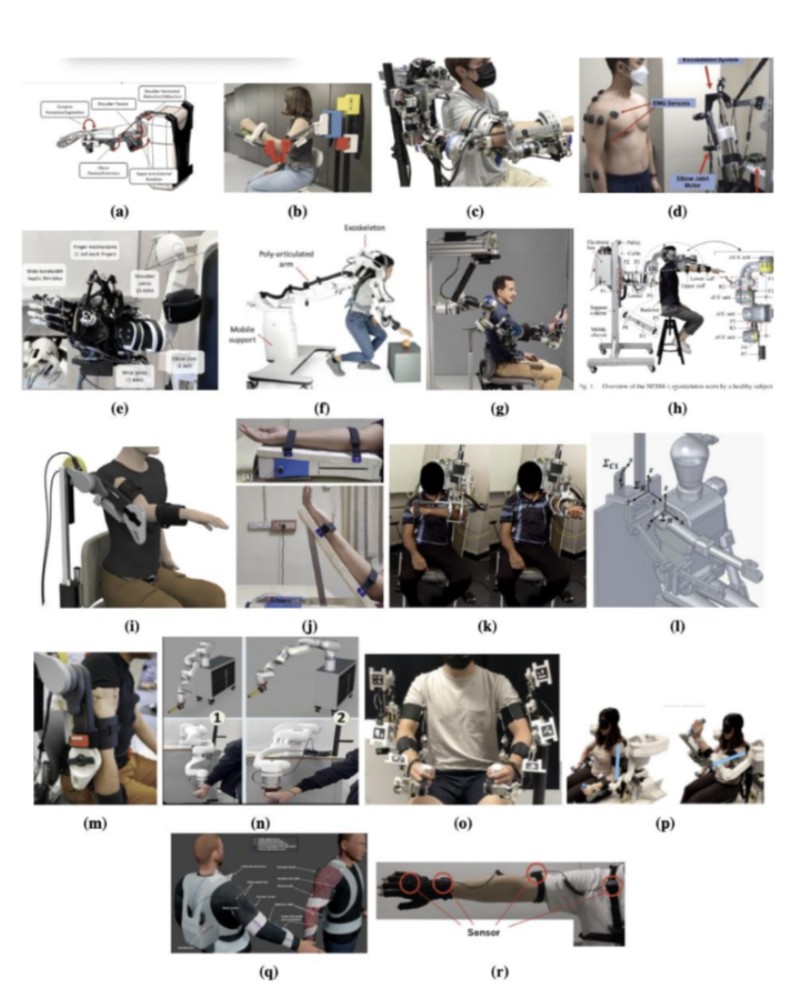
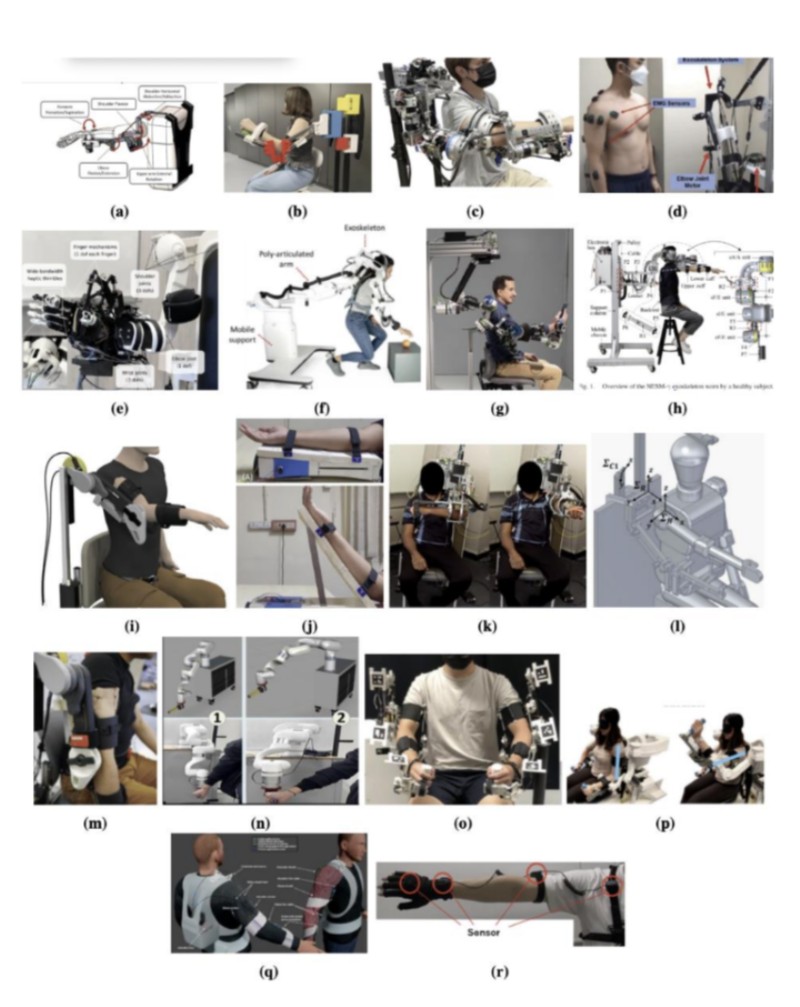
Sensory subsystems predominantly feature EMG for muscle activation monitoring (e.g., in CASIA-EXO, NESM-γ), IMUs for orientation/angular velocity tracking (often fused with encoders/cameras in xArm-5, POWERUP), force/torque sensors for interaction compliance (AGREE, BiEXO, ULIX for synergy detection), and kinematic encoders/potentiometers for precise trajectory feedback. Multimodal fusion (EMG+IMU+force) emerges as most promising for robust, real-time human-robot interfaces (ULIX, ANYexo, Quaternion Shoulder Exoskeleton), though it increases synchronization and processing complexity.
Clinical evidence remains limited: 21 studies involved healthy volunteers for safety/functionality baselines (e.g., NESM-γ transparency, AGREE versatility, CASIA-EXO adaptation); only two controlled trials (20 patients/8 weeks; 12 patients/10 days) reported superior shoulder/elbow mobility, reduced pain/abnormal synergies, and functional gains versus conventional therapy. Motor actuators dominate (19/32 systems) for precision and advanced control compatibility; cable designs offer compliance but limited torque; passive and soft actuators provide safety in early recovery.
Challenges include biosignal noise/drift, patient variability/fatigue, system cost/bulkiness, regulatory hurdles (CE/FDA), and sparse high-quality RCTs. Future directions highlight AI/deep learning for intention prediction, fully wearable/wireless sensors, soft exosuits, closed-loop neurorehabilitation (with FES integration), and larger standardized trials to bridge laboratory prototypes to routine clinical practice.
In conclusion, sensor-driven shoulder exoskeletons show strong potential to deliver personalized, intensive therapy unattainable through traditional methods. Multimodal sensing combined with adaptive/ML controls offers the greatest promise, yet broader clinical validation is essential to overcome current technical, economic, and evidentiary barriers and realize scalable impact in post-stroke upper limb recovery.